Meaning, once carried slowly through symbol, gesture, story, craft, ritual, and memory, is now increasingly passed through systems designed for speed. A word becomes a prompt. A picture becomes content.
A song becomes data.
A human thought enters the machine and returns altered, multiplied, accelerated — sometimes enriched, sometimes flattened, sometimes stripped of the symbolic weight that gave it human depth in the first place.
This is not a complaint against technology.
I would be the last person to say that tools are the enemy. Tools have always extended us: charcoal on cave walls, type on paper, lenses, printing presses, cameras, computers, networks, artificial intelligence. Each has changed not only what we make, but what we are able to imagine making.
But there is a cost whenever meaning changes hands.
In the run-up to what some call the Singularity — that shimmering, half-mystical, half-engineering threshold where human and machine cognition become difficult to separate — we are also passing through something older and stranger: a transvaluation of all values.
What matters? What is original? What is art? What is labour? What is memory?
What is merely generated, and what is truly made?
This site, A Life in Art, exists in that tension.
It is a gallery, an archive, a workbench, and a record of a long conversation between hand, eye, story, memory, and machine.
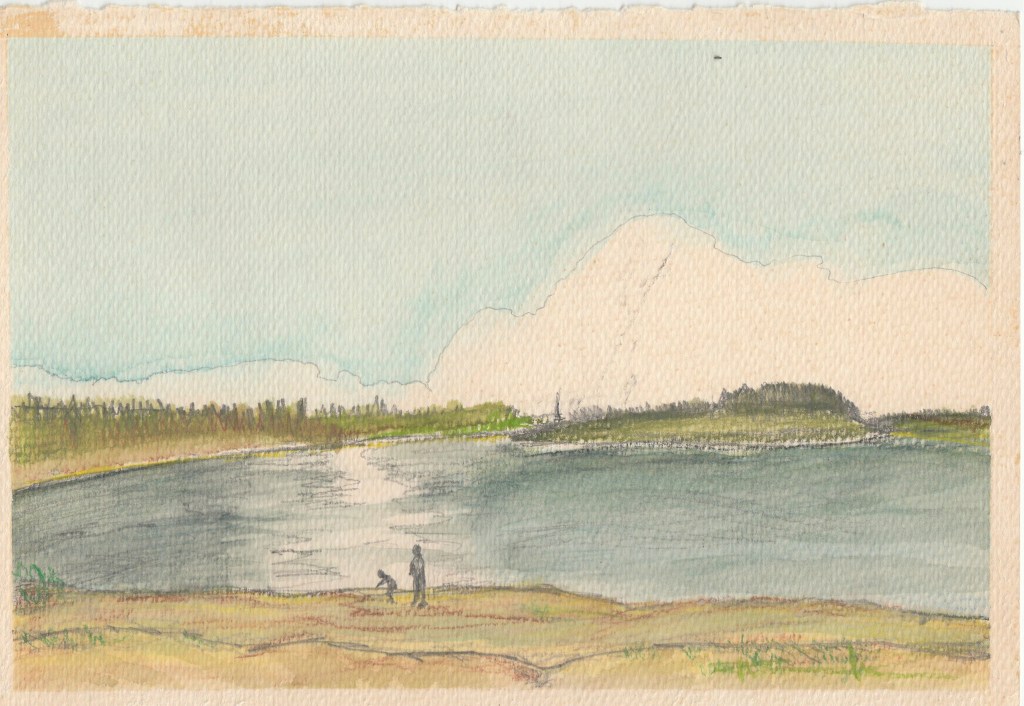
The early watercolours, the puppets, the woodblocks, the digital experiments, the novels, the strange new visual worlds built with AI assistance — all of them are part of one continuous question:
What survives when the tools change?
My current major writing project, The Berbian Chronicles, asks that question in story form. In that world, civilization has fallen, language has shifted, symbols have broken loose from their old meanings, and the fragments of the past are being reinterpreted by people trying to build something gentler from the wreckage. A thing once ordinary becomes sacred. A machine becomes a myth. A word becomes a relic. A puppet becomes a bearer of culture. A light in the dark becomes a reason to walk toward the future.
That is not just science fiction. That is where we are.
The transaction of meaning is underway. The symbols are changing hands.
The task of the artist, now as ever, is to notice what is being lost, what is being transformed, and what still carries fire.
And now, for something personal and pertinent –
I also want to pause here to remember John Varley, the science fiction author whose work helped teach me that speculative fiction could be more than prediction, gadgetry, or adventure. It could be art. For me, he belongs in the constellation that first made writing feel like a serious artistic calling: Ray Bradbury, with his lyric fire; Robert A. Heinlein, with his restless social engineering and argumentative futures; Jorge Luis Borges, with his labyrinths of mind and meaning; Stanisław Lem, with his philosophical machinery and cosmic irony; and John Varley, with his humane, electric imagination.
A character in The Berbian Chronicles bears the name Varley. In the book, Varley becomes a keeper of performance, puppetry, humour, and cultural memory. That felt right. Not a monument of stone, but a travelling theatre. Not a statue, but a voice. Not solemnity alone, but joy carried forward.
Because art is not decoration at the edge of civilization.
It is one of the ways civilization remembers why it exists. There is one sadness in this tribute that is hard to set down without making it too small.
When I first began this book, decades ago, one of my private happy fantasies was that, someday, when it was finished, I would send John Varley a copy. Not as a grand gesture. Not as a professional transaction. Just as a note of thanks from one writer to another — from someone whose imagination had been opened, widened, and permanently altered by his work.
I wanted him to see the character who carried his name. I wanted him to know that somewhere, in a future built out of ruins, memory, puppets, humour, and stubborn hope, there was a little flame burning partly because of him.
That will not happen now.
He will never see Varley walk onto the page in print. He will never meet the old performer, the keeper of story, the man who understands that culture is not an ornament added after survival, but one of the things survival is for. That loss sits quietly beside the work now.
But perhaps that is also how influence really travels.
Most of the writers who shaped us never know what they made possible. Bradbury did not know the exact children who would read him and suddenly understand that prose could glow. Heinlein did not know every argument he would ignite in a young mind. Borges did not see every reader who stepped into his labyrinth and came out differently arranged. Lem did not know all the future machines he taught us to mistrust, pity, or laugh at. Varley did not know every door he opened.
And yet the doors opened. So now, we go on.
Into the strange new worlds.
Into the paintings, the puppets, the stories, the broken symbols, the recovered meanings, the living archive, the imagined futures, and the handmade things that insist on carrying human touch forward.
This site is part of that journey. So is The Berbian Chronicles. So is every scrap of art that survives long enough to speak to someone who comes after.
The symbols change hands. The hands change the symbols.


Leave a comment