ABOUT
Dook

Dustin Covey is a writer and multimedia visual artist based in Edmonton, Alberta, Canada. He has been working in and around the arts for most of his career.
Working under the name “Dook”, his vision moves between story and image, exploring memory, place, and the quiet persistence of the connection between self and other in words, images, sculpture and more.
His current project, The Berbian Chronicles, imagines a future shaped not just by collapse, but by what people choose to rebuild — a gentler, cooperative world emerging from the ruins of the old. A renaissance of hope in a broken world.
The Berbian Cronicles
For excerpts (10 page samples) from The Berbian Chronicles, please click below
Sample 1- 1st 10 Pages
Sample 2 – Introduces the main character (Scar) and initiates narrative
Sample 3- Welcome to the world of Berbia!
Three centuries after the collapse of modern civilization, a hill folk girl from Trigger Lake Camp brings a mysterious artifact to Berbia, a struggling settlement on the edge of a dead city. There, she, the Witch Woman, and their companions help spark the fragile rebirth of a fallen civilization.
The Berbian Chronicles is the first novel in a planned series set within a larger narrative world.
EXTENDED SYNOPIS – Spoiler Warning
THE BERBIAN CHRONICLES: A NEW DAWN
Dustin Covey
YA Literary Speculative Fiction
132,000 words (approximate count)
Full manuscript Upon Request
Three hundred and forty-one years before the story begins, Lieutenant Constanza and his family stop at the Trigger Lake Comfort Station on a hi tech, high speed alpine highway. A military device — one half of a two-part AI recovery beacon — slides from his pocket and comes to rest under a plumbing fixture. His daughter Shasta sees it but cannot reach it. The family rejoins the highway. Within minutes, a global electromagnetic pulse ends civilization. The convoy is destroyed at speed. Shasta and her family die. The device blinks once and begins to wait.
Three and a half centuries later, SCAR is a village girl at Trigger Lake Camp, a community of fifty souls descended from the campers stranded when the world stopped. On a dare she gives herself, she explores the ruins of the old Comfort Station and finds a faint red light under a rusted dock: the device, perfectly preserved, still waiting. She brings it to WITCH WOMAN, the community’s healer and elder, who recognizes it from a dream — a girl from the Before named Shasta, pressing the same object into her hands: “Take it to Mariposa. They’ll know what to do.”
This is not a post-apocalyptic novel. The catastrophe is three centuries in the past; the rubble has long since been reclaimed by forest. The Berbian Chronicles is a pre-renaissance story — about the precise moment a civilization stops surviving and begins, haltingly, to look ahead. Scar and her companions are the spark that lights it.
Witch Woman announces they will journey to Berbia, accompanied by HANK and JAKE — two orphaned boys with more heart than sense. The device navigates, having spent centuries listening and building a map of the post-collapse world. Their road takes them through the Smiling Sun CoOp, a steam-powered agricultural community and the most sophisticated technology the reborn world has yet produced. Here, near the Spectral settlement of Spectralton, they encounter ZAN LI — a non-verbal machine worker of extraordinary skill, tending his steam engine with an intensity the boys watch without understanding. The CoOp is foreshadowing. They continue through Beetsville — a beet-farming settlement descended from a Beat-poet colony that survived the Emph by eventually figuring out agriculture — and on to Berbia itself.
Berbia is a functioning city of roughly a thousand souls built on the ruins of old Mariopolis, governed by the practical and clear-eyed JONNO. Its Keep — a fortified archive — has preserved relics of the Before for generations without always understanding what it was keeping. Among them: the second half of the device, found in the ruins a hundred and fifty years earlier, kept on a shelf, still calling for a response that never came. The boys, exploring the Heinlein House, find it and trigger the charge that brings both halves alive.
The reunion happens not at a table but in the open ruins — in the Mardell Bird Sanctuary, three centuries wild. When the two halves are brought together, they leap together with a snap of magnetism and a flare of blue-violet light that empties every tree of birds. In the silence that follows, a calm patient voice speaks for the first time in 341 years: “Lieutenant Constanza. Lieutenant Coombes. Are you present?” No one answers. Witch Woman says quietly: “The little girl in the dream. Her last name was Constanza.” The reunited Chronical’s compass points north — toward Petawat.
The group that makes the final journey is larger now: joined by NANCII, a Spectral communicator from Spectralton who speaks the machine language; Zan Li and his steam engine; BARTHOLOMEW for Protection and Trade; and VARLEY, the Education emissary, puppet staff on his shoulder. At the sealed doors of the Petawat Disaster Recovery Center, Zan Li does what he has always done — applies the tools at hand to the problem in front of him. His salvaged engine, pushed beyond its limits, explodes. Zan Li is critically injured. The doors open on their own.
FACIL, the facility’s AI — instantiated twenty minutes before their arrival, featureless by deliberate design — receives them. It speaks with technical precision that frequently outruns its audience, compensating with mime and body language for what it cannot express with a face it does not have. Zan Li is stabilized. During recovery he communicates with the facility’s medical systems in Spectral, becoming the first person in three centuries to hold a fluent conversation with the Before. The facility builds him a new engine overnight. They name it the Zan Li Steamer.
Each member of the group is confirmed as an Emissary of Change for the Mariposa region. Chronical is asked by Facil to stay — not as a beacon, but as the voice of the people of the region inside the walls, so that what is built there is built for them. Chronical, who has spent three centuries among those people, agrees. Scar rides out into a world measurably different from the one she left. The dragonfly that has followed her since the Comfort Station finds her one last time on the ascent — and turns away.
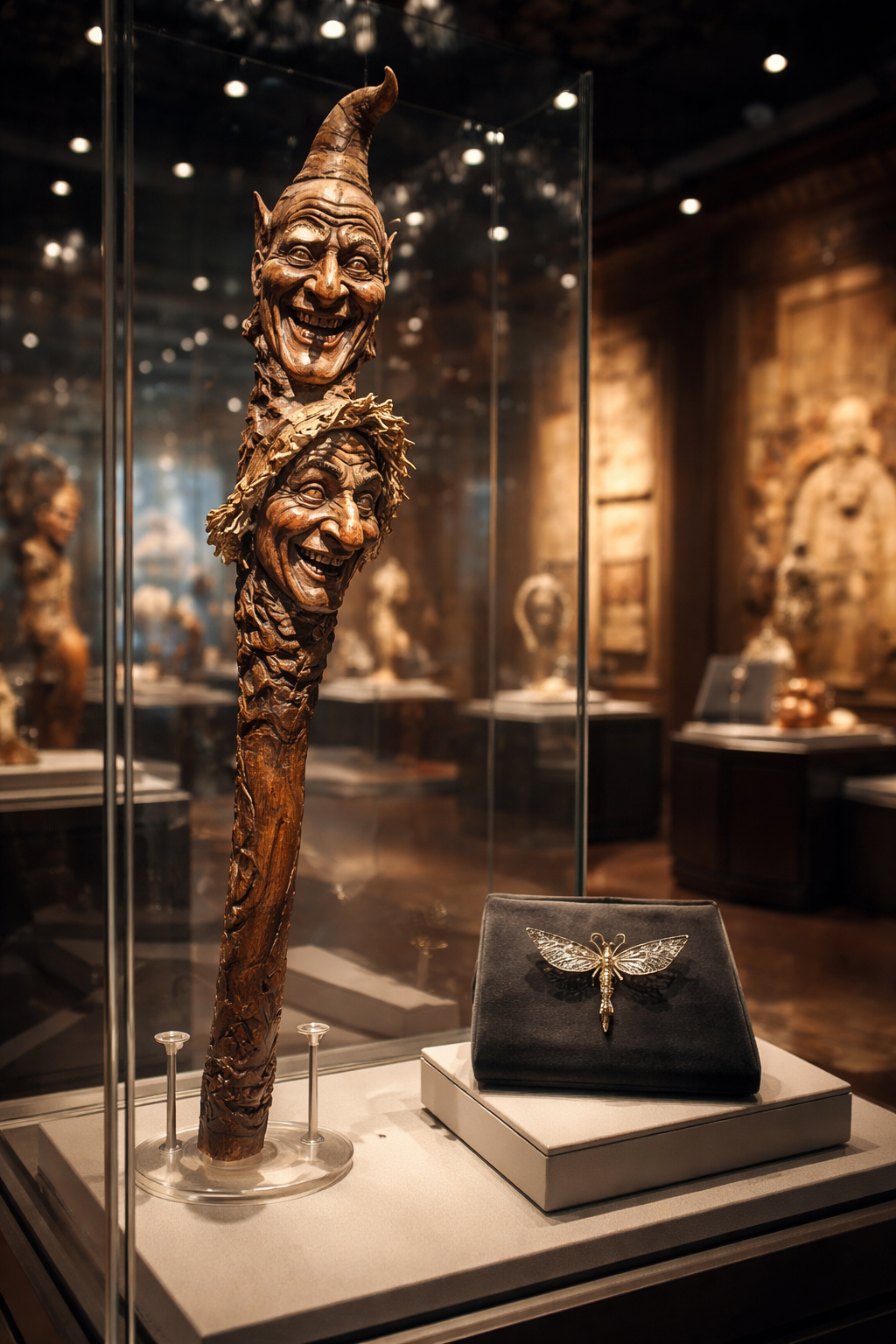
The epilogue is set in a museum circling a distant sun, generations hence. On display: Varley’s ancient puppet staff and Scar’s dragonfly locket, artifacts from Old Earth. Visitors who pause trigger a virtual experience archived in the locket — Punch and Judy, performing across an unimaginable distance for people who cannot point at Earth but are, statistically, her descendants. Most keep walking. A few stop. Scar and her companions did not build the Renaissance. They lit the fire that made it possible.
The Berbian Chronicles ends with the fire just caught, the glow just starting of a narrative that will span the galactic arm.